|
|
Bulletin of the Chemists and Technologists of Bosnia and Herzegovina
Issue 65
Publication date: December 2025 |
|


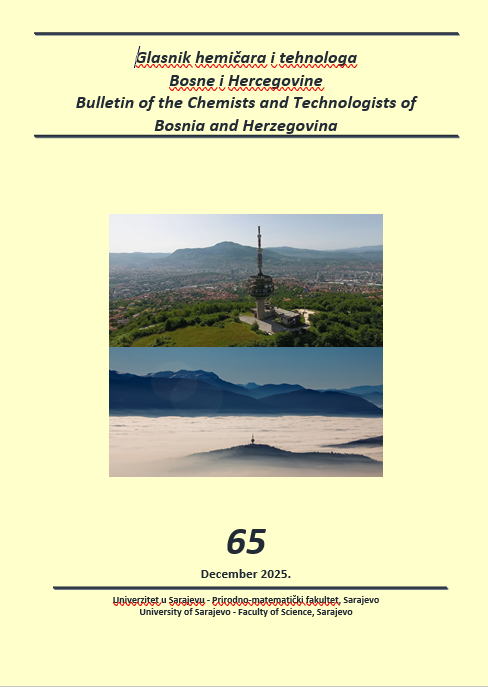
Table of contents
Occurrence of Selected Persistent Organic Pollutants in Bosnia and Herzegovina: A systematic Reviewt Original Scientific Article
Lugušić Aida, Porobić Amina, Đeđibegović Jasmina
DOI: 10.35666/2232-7266.2025.65.01
UDK: 628.4.042:502]54(497.6)
Abstract: Persistent organic pollutants (POPs) are compounds that are recognized as significant health and environmental hazards, and their use and emission have been restricted or limited by the Stockholm Convention. Despite the control measures foreseen by the international treaties, the presence in the environment is still evident. Bosnia and Herzegovina is a party to the Stockholm Convention, but regular integrative monitoring of POPs occurrence in the environment has not been established. Data on POPs concentrations reported by various research groups and institutions are scattered in the available publications, making a general assessment difficult. This paper aims to summarize data on the presence and levels of selected POPs in environmental and biological samples from Bosnia and Herzegovina, which can aid in planning further monitoring actions, the assessment of effects of already implemented control measures, and policy decision making. The main findings indicate the presence of organochlorine pesticides (OCPs), polychlorinated biphenyls (PCBs), and polycyclic aromatic hydrocarbons (PAHs) in most of the matrices (soil, air, water, sediment, and certain food). Potential ecological or health risks cannot be excluded in respect to heptachlor (Bosna river basin), dichlorodiphenyltrichloroethane (in free-range hen eggs), PCBs (in free-range hen eggs and in Modrac Lake sediment), and PAHs (in agricultural soil in Spreča valley and in sediments from Bosna and Spreča rivers).
Bulletin of the Chemists and Technologists of Bosnia and Herzegovina 65, 01-19
The Impact of Selected School Experiments on Pupils' Attitudes Toward Chemistry Original Scientific Article
Ilić Božidar, Subotić Siniša, Balaban Milica, Zeljković Saša
DOI: 10.35666/2232-7266.2025.65.02
Abstract: School experiments, as a teaching method, represent one of the visual ways of explaining relevant natural phenomena to pupils. The application of experiments in chemistry teaching is often interpreted as an excellent way to achieve good learning outcomes. The impact of conducted school experiments on pupils was examined using psychological instruments, administered before and after performing the selected school experiments in front of the pupils. Feedback from 143 respondents, pupils from primary and secondary schools in Bosnia and Herzegovina, was collected. Adequate statistical analysis was performed. Two key measures were identified: Affinity towards Chemistry and positive experiment experience. A slight but significant increase in the affinity scores was noted after demonstrating school experiments, showing a mildly positive impact on students' attitudes toward chemistry. Positive Experiment Experience scores were high, indicating a favorable perception of the demonstrations. The data suggest that students' initial affinity towards chemistry is the best predictor of their attitudes after the experiment, suggesting that pre-existing attitudes are key. No evidence was found for a "magic" intervention that significantly changes students' affinity. These findings highlight the importance of continuous engagement over isolated demonstrations, which alone cannot replace the impact of ongoing work with students.
Bulletin of the Chemists and Technologists of Bosnia and Herzegovina 65, 21-28
Phenolic Profile and Antioxidant Activity of Selected Premium Wines from Herzegovina Region Original Scientific Article
Kazazic Maja, Marino Chiara, Mehic Emina
DOI: 10.35666/2232-7266.2025.65.03
UDK: 543:663.21(497.6-82)"2019/2021"
Abstract: Red wines are rich in antioxidants, which have anti-inflammatory activity and beneficial effect on human health. The aim of this research was to determine the content of bioactive compounds, i.e. total phenols, anthocyanins and tannins, as well as antioxidant activity in red wines from the Herzegovina region. Four wines from two different harvest years, i.e. 2019 and 2021, were analysed. Phenolic compounds are important wine quality parameters that affect color, taste and aroma. The content of total phenols varied from 1733.87 ± 10.22 to 2382.09 ± 21.42 mg GAE/L. The content of total anthocyanins, which directly affect the color of red wines, was determined by the pH differential method and the results obtained ranged from 13.64 ± 0.19 to 21.76 ± 0.35 mg CGE/L. Total tannins were determined using spectrometric method, and values ranged from 9.00 ± 0.09 to 11.42 ± 0.21 g/L. The antioxidant activity was assessed using two different methods, FRAP and ABTS. The total phenolic content of the tested wines was positively correlated with their antioxidant activity. The content of total phenols, anthocyanins, tannins and antioxidant activity were influenced by the year of harvest as well as the aging methods used.
Bulletin of the Chemists and Technologists of Bosnia and Herzegovina 65, 29-34
Electrochemical Behaviour of Aluminum in Artificial Seawater in the Presence of Artemisia annua L. Proceedings
Zlatić Jelić Gloria, Pilić Zora, Martinović Ivana, Čelan Stipe, Pejak Lidija
DOI: 10.35666/2232-7266.2025.65.04
UDK: 544.08[546.62:621.564.3]
Abstract: This study investigated the use of Artemisia annua L. aqueous extract as a corrosion inhibitor for aluminum in artificial seawater using cyclic voltammetry (CV), potentiodynamic polarization (PP) and electrochemical impedance spectroscopy (EIS) measurements. The surface film formed on the Al in the presence of A. annua was analyzed using Fourier-transform infrared (FTIR) spectroscopy. Electrochemical results showed that A. annua is a mixed type inhibitor of Al corrosion with predominantly anodic action and is changing the electrochemical behavior of Al in artificial seawater by inhibiting dissolution processes. The inhibition efficiency of ∼91% was attributed to the formation of a homogenous multilayer composed of phenolic acids. According to the results of FTIR analysis, the adsorption was established through the carboxyl group of phenolic acids, where stabilization of the adsorption layer was achieved through interactions between aromatic rings and the aliphatic chains. The adsorption mechanism obeyed the Freundlich isotherm model and El-Awady kinetic-thermodynamic models and referred to physical adsorption (ΔGads = 18.83 ± 2.34 kJ mol−1).
Bulletin of the Chemists and Technologists of Bosnia and Herzegovina 65, 35-44